___ Covid-19 ___
Coronavirus
1. INTRODUCTION
2. EFFECTIVENESS, SAFETY AND TOXICITY OF CHLORINE DIOXIDE

The Covid-19 pandemic shocked the world and has claimed many thousands of lives, and as one of the equally complicated consequences, the world economy was compromised. Undoubtedly, this is a problem that required an urgent solution and the commitment of everyone, especially health personnel, in the search for its prompt solution.
In order to identify a solution to this problem and also based on the scientific evidence already published and clinical experiences of use of chlorine dioxide (ClO₂) by physicians and researchers, we made an assessment of the main information to support our proposal for the use of chlorine dioxide solution (CDS), following the protocol standardized by Dr.h.c. Andreas Ludwig Kalcker as a safe and effective alternative to combat infection by SARS-COV2.
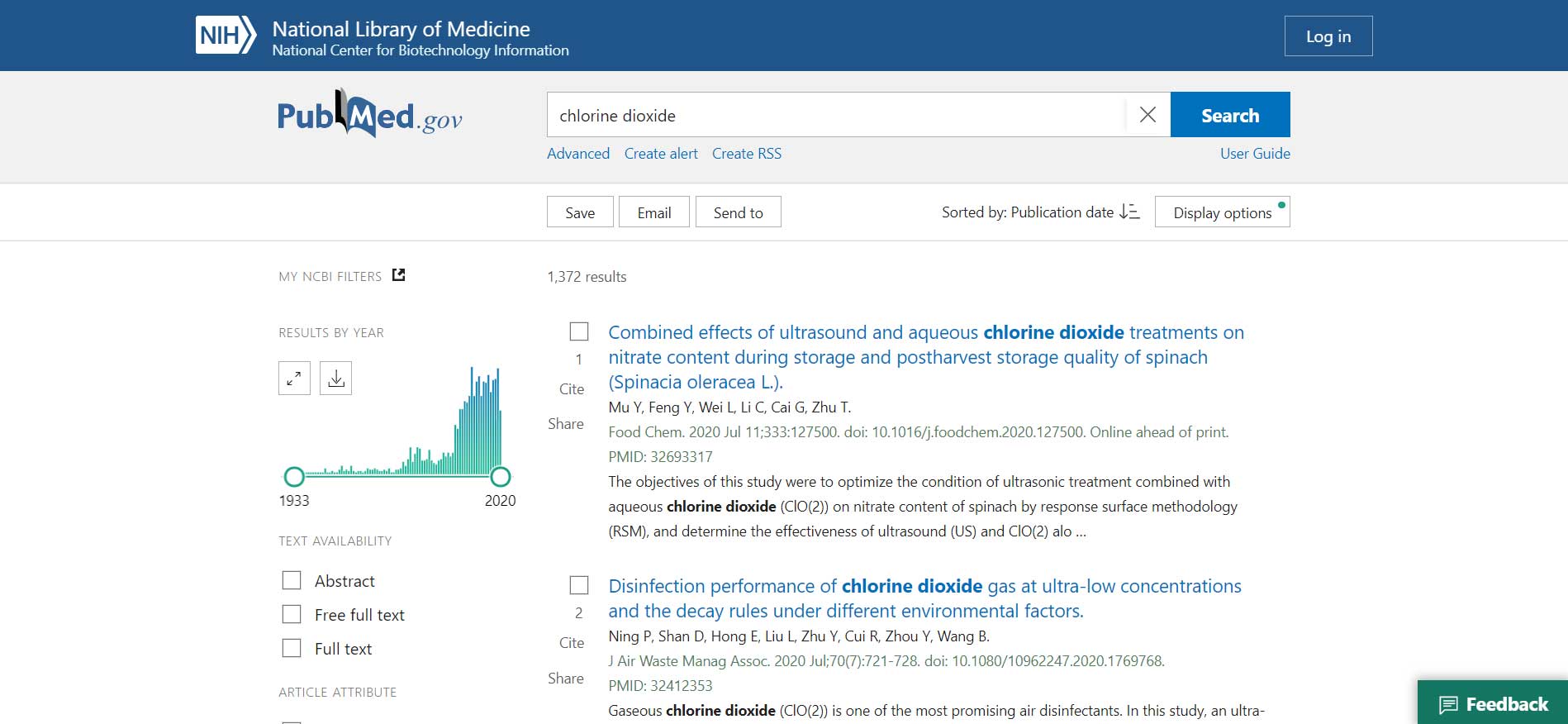
A review survey on the use of chlorine dioxide in the indexed international literature was carried out from January to July 2020 and as an example, if we analyzed only the PubMed website (National Library of Medicine 2020), we observe that only using the descriptor “chlorine dioxide”, we have available a total of 1,372 documents dating from 1933 to the research date, 2020 (Figure 1).
1.1 BACKGROUND
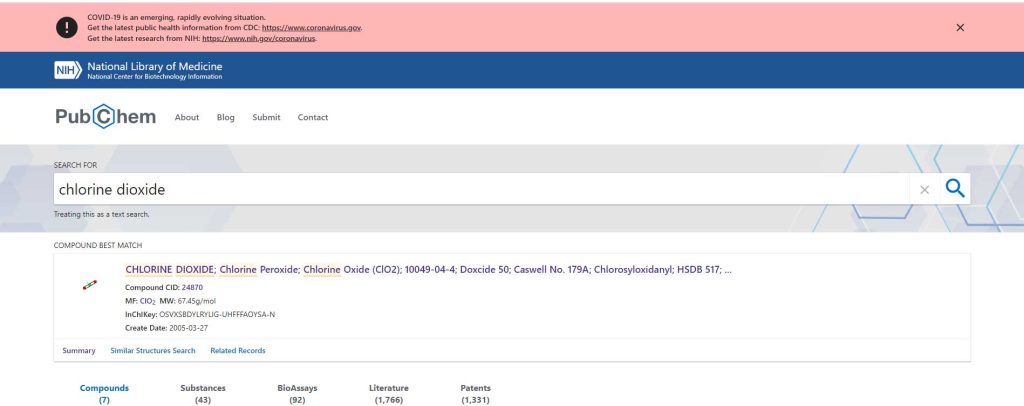
Another important source was the PubChem database (Figure 2), in which it is also possible to identify biochemical and toxicological information, among others, and registered patents (which can also be found in Google Patents), among which the following stand out:
1) The patent on the disinfection of blood bags (Kross & Scheer, 1991);
2) The patent on HIV (Kuhne 1993);
3) The patent on the treatment of neurodegenerative diseases such as amyotrophic lateral sclerosis (ALS), Alzheimer’s disease and multiple sclerosis (McGrath MS 2011);
4) Taiko Pharmaceutical’s patent (2008) for human coronavirus;
5) the patent on um method and composition “for treating cancerous tumors” for treating cancerous tumors (Alliger 2018);
6) the patent on pharmaceutical composition for treating internal inflammation (Kalcker LA, 2017);
7) the patent on pharmaceutical composition for the treatment of acute intoxication (Kalcker LA, 2017) and;
8) the patent on a pharmaceutical compound for the treatment of infectious diseases (Kalcker LA, 2017);
9) the patent on the use of CDS for coronavirus type 2 (Kalcker LA, 2020 – still pending publication: /11136-CH_Antrag_auf_Patenterteilung.pdf).
Therefore, with these initial data alone, we note that research on ClO₂ is nothing new, that it is a chemical molecule already known for more than 200 years and marketed for 100 years with various uses: treatment of water for human consumption, treatment of contaminated water, for biofilm control in cooling towers and in the processing of food and vegetable disinfection.
In addition, since 40 years there are clinical and clinical studies conducted, as well as studies that allow us to understand its toxicological and safety characteristics especially for human use (Lubbers et al 1984, Ma et al 2017).
1.2. A BRIEF SUMMARY OF CHLORINE DIOXIDE
The chemical formula of chlorine dioxide is ClO₂ and according to the Chemical Abstracts Services (CAS) from Chemical American Society its CAS number is 10049-04-4. In this formula, it is clear that there is one chlorine atom (Cl) and two oxygen atoms (O₂) in a chlorine dioxide molecule. These 3 atoms are held together by electrons to form the ClO₂ molecule. It can be used as a saturated gas in distilled water and can therefore be drunk or applied directly to the skin and mucous membranes, with appropriate dilutions. Andreas Ludwig Kalcker, Biophysicist and Researcher, standardized a saturation of the gas in distilled water called chlorine dioxide solution or CDS (National Library of Medicine 2020).
The discovery of the ClO₂ molecule in 1814 is attributed to the scientist Sir Humphrey Davy. ClO₂ is different from the element chlorine (Cl), both in its chemical and molecular structure, as well as in its behavior. ClO₂, as has already been widely reported, can have toxic effects if the necessary care is not observed for its various uses and the appropriate recommendations for human consumption are not respected. It is more than well known that clo2gas is toxic to humans if inhaled pure and/or ingested in quantities higher than recommended (Lenntech 2020, IFA 2020).
ClO₂ is one of the most effective biocides against pathogens such as bacteria, fungi, viruses, biofilms and other species of microorganisms that can cause disease. It acts by disrupting the synthesis of the pathogen’s cell wall proteins. As it is a selective oxidant, its mode of action is very similar to phagocytosis, where a mild oxidation process is used to eliminate all types of pathogens (Noszticzius et al 2013, Lenntech 2020). It is worth saying that ClO₂, generated by sodium chlorite (NaClO₂), is approved by the Environmental Protection Agency in the United States (EPA 2002) and by the World Health Organization for use in water fit for human consumption, as it leaves no toxic residues (EPA 2000, WHO 2002).
When applied at appropriate concentrations, ClO₂ does not form any halogenated products and its residual ClO₂ by-products are normally within the limits recommended by EPA (2000, 2004) and WHO (2000, 2002). Unlike chlorine gas, it does not hydrolyze readily, remaining in the water as a dissolved gas. Also in contrast to chlorine, ClO₂ remains in molecular form in the ph ranges commonly found in natural waters (EPA 2000, WHO 2002). WHO and EPA include ClO₂ in Group D (substances not classifiable in terms of human carcinogenicity) (IARC 2001, EPA 2009). According to the U.S. Department of Health and Human Services 2004, the FDA recommends that ClO₂ be allowed for use as a permitted food additive and as an antimicrobial agent (disinfectant).
Many continue to confuse ClO₂ with sodium hypochlorite (NaClO – Bleach) and the latter with sodium chlorite (NaClO₂), as well as other chemical compounds, leading to frequent inappropriate comments both in the media and among professionals due to lack of knowledge of elementary chemistry. NaClO (bleach), for example, is a potent corrosive agent and the danger due to chronic and massive exposure to NaClO is well known. It is believed that asthma symptoms developed by professionals working in contact with that substance may be due to continuous exposure to lye and other irritants.
In contact with fats, sodium hydroxide (NaOH) degrades fatty acids into glycerol and soaps (fatty acid salts), which reduces the surface tension of the remaining fat-solution interface. NaClO is responsible for the dissolution of organic tissue. Thus, it is observed that the main toxicity of the substances generated from the chemical reactions of sodium hypochlorite is the appearance of a hydroxyl NAOH radical, in the various reactions with the secretions and chemical structure of human tissues (Daniel et al 1990, Racioppi et al 1994; Estrela et al 2002, Medina-Ramon et al 2005, Fukuzaki 2006, Mohammadi 2008, Peck B et al 2011).
Based on this brief review of what chlorine dioxide is and its biocidal capacity, the results obtained by the physicians of the Ecuadorian Association of Specialists in Integrative Medicine (AEMEMI) are not surprising: Who claim the administration of CDS in appropriate and safe dilutions is an effective and low-cost alternative that can rapidly contribute to the restoration of health of the individual infected by human coronavirus type 2, and it is assumed that it can promote the reduction of morbidity and mortality, hospitalizations by COVID-19 mostly, up to 4 days (AEMEMI 2020).
Through evidence from available scientific publications demonstrating the efficacy of ClO₂ in eliminating different pathogens (Kullai-Kály et al 2020), including SARS-CoV (Tables 1, 2, 3 and 4; Taiko Pharmaceutical patent 2008), as well as the work confirming the safety of the use of chlorine dioxide for water potabilization and, more recently, the aforementioned work of AEMEMI, we evaluate positively and with great biocidal potential the use of aqueous ClO₂ solution (CDS) to combat coronaviruses (AEMEMEMI 2020, EPA 2000, WHO 2005, WHO 2002).
In this context, we are surprised that official bodies such as the Ministries of Health, PAHO/WHO and regulatory agencies and/or health entities do not recommend the use of ClO₂ and all, instead of recommending it, draw attention to its toxicity and danger, but, in their speeches, do not clearly indicate in what form and by what route of administration ClO₂ is really toxic. However, everything leads us to understand that they are referring to the pure and concentrated form of this gas and not to the formula standardized by Kalcker: the aqueous solution of chlorine dioxide (CDS), at 3,000 ppm.
Thus, to help clarify the concepts, we invite all official bodies to learn about Kalcker’s work with the aqueous solution containing gaseous chlorine dioxide (CDS). Certainly, after having this knowledge, we believe that definitely, these Agencies, which appreciate health, will naturally understand the potential of this solution for human use and from then on, they should revise their documents which may be at odds with the published scientific reality and current medical experiences and maybe they can offer this information in a clearer and more assertive way in their articles published on official websites or even in their documents.
1.3. KEY POINTS FOR REFLECTION
In view of the serious scenario to which the whole world is exposed with the coronavirus pandemic, we address the authorities and institutions responsible for human health that lead the main institutions to ask them the following questions:
What could be the purpose/impact of disclosing a document with information that can be misinterpreted?
Is there a purpose to hide and/or translate scientific knowledge in a way that causes doubt or harm to the health of thousands of people, and prevent them from benefiting from something that can really save lives?
What is the purpose for not using so-called “unconventional” but potentially promising options with proven clinical evidence by physicians who are on the front line with COVID-19?
With the legally established purpose of saving lives, it is neither logical, nor healthy, nor even less a humanitarian and compassionate action, in the face of a global public emergency situation, that misunderstandings in the translation of scientific knowledge occur for any purpose other than the preservation of life. We consider that these concepts that generate misunderstandings may be caused due to lack of knowledge of the existing literature (even though it is open for public consultation). To recall: in the PubMed database alone, there are more than 1,300 documents published using only the descriptor “chlorine dioxide”.
Assuming that the team in charge of writing the official documents, the articles, the reports published on the websites of official bodies such as PAHO/WHO of the member countries, the Ministries of Health and the health regulatory bodies, were not aware of the articles and patents (which does not exempt them from legal responsibility) where they prove the non-toxicity at these doses and the possible benefits of chlorine dioxide for human health and that, therefore, these teams in charge still do not consider the potential of ClO₂ for the fight against coronavirus type 2, as the AEMEMI and the team of Doctors and Researchers who sign this dossier have done, we invite you to reflect on the following:
-There are many scientific bases for public access, with many articles freely available, containing the necessary information for the production of a document to support a decision in public management, why were these bases not consulted or poorly analyzed or simply not considered? For what reason? After all, it is an important decision to use or ban a substance for human health, in a context of global public emergency to overcome COVID-19.
-How is it possible that the official, legally responsible health agencies would make such an important decision without a thorough analysis of the effects of banning a substance that could simply end the pandemic quickly, safely and effectively?
-The fact is that any neophyte in the matter who reads the different official publications coming from some health agencies about ClO₂ will naturally be afraid of consuming this product because he thinks that it is toxic and harmful to health, and that it could endanger his life. Likewise, a health professional would also be afraid to use it in his therapeutic practice, since he might loose his medical license.
Based on the dissonant and inconsistent information when compared to what is actually known about CDS and its potentiality is that we, health professionals in the intention to respectfully give our contribution for the governing institutions of health to review their documentation and officially published guidelines to promote the clearest and most truthful information on the use, efficacy and safety of ClO₂ for oral human consumption (CDS), according to the standardized by Kalcker (2020 – On evaluation: /11136-CH_Antrag_auf_Patenterteilung. pdf), we share below a summary of the key scientific facts and evidence that CDS is effective against several pathogens, including human coronavirus type 2, the etiological agent of SARS-CoV2.
Unfortunately, the way in which information about ClO₂ is disseminated raises doubts and above all reveals to those who understand the scientific aspects of the subject that the misinformation generated is somewhat surprising.
1.4. WHAT IS CHLORINE DIOXIDE SOLUTION (CDS) AND WHAT ARE THE DIFFERENCES WITH MIRACLE MINERAL SOLUTION (MMS)?
More than 17 years ago, Andreas Ludwig Kalcker started scientific research to study the applicability of ClO₂ and its dilutions, so that it can be safely used for human consumption. On the basis of these studies, he has developed 4 patents, of which 3 are published and one is pending approval. These studies are based on the safe toxicity levels established by the German toxicology database Gestis (IFA 2020), and take into account other reference studies already developed, for example, by WHO (2000, 2005) and EPA (2000).
These studies confirm the non-toxicity of this gas in aqueous solution for human consumption and establish, for example, that the safe dose is 0.3 mg/L to be used for drinking water. Kalcker’s studies and the clinical experiences of Doctors, recommend using 10 mí of this concentrated solution, diluted in 1000 mí of water as one of the protocols to combat SARS-COV 2. In this specific recommendation, it is allowed at the end, the consumption of 30 mg/day, divided into 10 doses of 100mL, which is safe and non-toxic based on recognized scientific references (Lubbers & Bianchine 1984; Ma et al 2017).
The unnecessary controversy and its consequences
Contextualizing the origin of the misguided controversy that has arisen over the “chlorine dioxide” issue, it is important to clarify: Historically, a product called “miracle mineral solution” (MMS) has been the subject of much controversy in the media around the world because it is sold as a “medicine.”
We often see news stories on the Internet confusing “miracle mineral solution” (MMS = citric acid + sodium chlorite + water) with “chlorine dioxide solution” (CDS = hydrochloric acid + sodium chlorite + water) and the latter with sodium hypochlorite (bleach). The main differences between MMS and CDS can be conferred in Table 1:
Main characteristics | MMS | CDS |
ClO₂ Concentration (parts per million – ppm) | unknown | 3.000 ppm |
Ph | Acid | Neutral (7) |
Residue | Chlorates, chloride | No residue |
The consequences and impact of these failures in the translation of scientific knowledge at a time of global public health emergency, when the lives of many people are at risk, are worrying.
Therefore, it is urgent that all institutions are alert through the prior qualification of the information that is published so that there are no failures in the translation of scientific knowledge, thus generating space for doubts and misinterpretations through the media, with serious consequences and negatively influencing the decision making of managers.
If we were to use sodium hypochlorite (NaClO) with hydrochloric acid in water, the solution would contain Cl₂ + NaCl + H₂O. Cl₂ is a toxic gas that reacts with organic substances, mainly in aqueous media where it can form toxic acids.
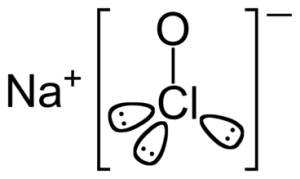
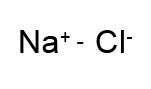
Although we are clear about the well-established biochemical differences, many still confuse some chemicals with ClO₂ (Table 2):
| CHEMICAL COMPOUNDS | |||||||
| BIOCHEMICAL CHARACTERISTICS | Sodium Perchlorate | Sodium Chlorate | Sodium Chlorite | Sodium Hypochlorite | Sodium Chloride | Chlorine | Chlorine Dioxide |
| Structure | 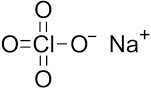 |
 |
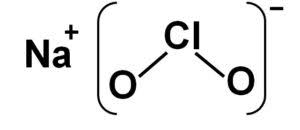 |
 |
 |
 |
 |
| Chemical Formula | NaClO4 | NaClO3 | NaClO2 | NaClO | NaCl | Cl2 | ClO2 |
| Molecular Weight | 122.44 g/mol | 106.44 g/mol | 90.44 g/mol | 74.44 g/mol | 58.44 g/mol | 70.9 g/mol | 67.45 g/mol |